Queer Places:
156 Brattle Street, Boston, MA 02110
Mount Auburn Cemetery, Cambridge, Middlesex County, Massachusetts, USA
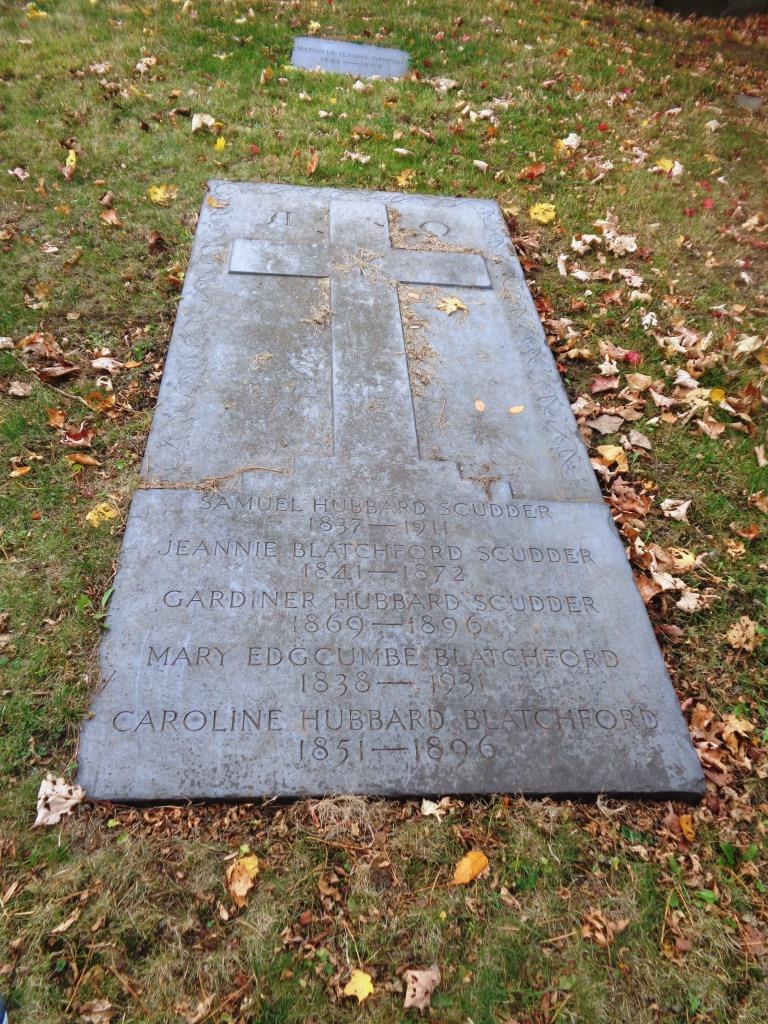 Mary Edgcumbe Blatchford (August 13, 1838 - July 13, 1931) was born in New York City on August 13, 1838, to New York lawyer Edgecombe Heath Blatchford
(1811–1853) and Mary Ann Hubbard (1820–1864), who hailed from Boston. She grew up as part of a prominent family with deep New England connections, being
a first cousin of Mabel Hubbard, who famously married Alexander Graham Bell. Her siblings included Jeannie Blatchford Scudder (1841–1872), Alice Windeath
Blatchford (1843–1845), Grace Vernon Blatchford (1845–1861), and Caroline Hubbard Blatchford (1851–1896). As a youth, Mary was sent to Switzerland to
pursue her education.
Following the death of her father in 1853, Mary and her mother relocated by 1860 to Craigie Street in Cambridge, Massachusetts. Mary spent the
remainder of her life in Cambridge, where she became deeply involved in intellectual, literary, and educational causes. Driven by a passion for
education, she was drawn into the influential circle of social reformer Abby Williams May, who was a cousin of
Louisa May Alcott and a pioneer in women's suffrage, education reform, and civic activism.
Blatchford was also an author of children's literature, publishing works such as The Story of Little Jane and Me (1898) and Polly and the Aunt (1906).
For many years, she resided at 156 Brattle Street—located at the corner of Lowell and Brattle Streets—living with her sister Jeannie's widower, her
brother-in-law Samuel H. Scudder, as recorded in the 1900 United States Census alongside household members Mattie Olmond and Nora Sexton. She officially
purchased the 156 Brattle Street residence in 1903.
In 1889, a year after the death of her dear friend Abby Williams May, Blatchford commissioned an architect to design a memorial tribute. She submitted
a formal request to the Cambridge City Committee on Water Supply and Drainage for permission to erect a granite structure at the prominent intersection
of Craigie and Brattle Streets, in front of 27 Craigie Street. Constructed of two large granite blocks measuring nine feet by nine feet and
two-and-a-half feet thick, the structure served primarily as a watering trough for horses with an accessory drinking fountain for humans. Encircled by
the inscription "Abigail Williams May, born April 21, 1829, died Nov. 30, 1888" above two carved sprays of wheat, the monument was praised by local
leaders and media, including The Cambridge Press and The Cambridge Chronicle, for its practical utility and ornamental value to man and beast. Because of
its unique circular shape and central placement in a busy junction, the intersection became widely known as "Washtub Square."
By 1922, the city ceased using the structure as a water trough and planted flowers in its upper basin. However, with the rise of automobile traffic,
the landmark came to be viewed as a traffic hazard. In January 1925, at the age of 87, Blatchford generously consented to the City Council's decision to
demolish the memorial after 36 years of service, though the location retained its historic moniker long after.
Mary E. Blatchford outlived her friend Abby W. May by 43 years, passing away in Cambridge on July 13, 1931, at the age of 92. She was interred on July
14, 1931, in Lot #4260 on Myrtle Path at Mount Auburn Cemetery in Cambridge, Massachusetts.
References:
- The Cambridge Historical Commission Blog: Washtub Square (Article by Kathleen M. Fox), detailing Blatchford's life in Cambridge, her relationship with Abby Williams May, and her role in constructing and decommissioning the memorial watering fountain at Brattle and Craigie Streets.
- History Cambridge (Cambridge Historical Society) Archives: Photographic collections, municipal historical documents, and street neighborhood records documenting "Washtub Square" and 156 Brattle Street.
- The Cambridge Chronicle: April 6, 1889 – Formal request by Mary E. Blatchford to erect a memorial fountain.
- November 9, 1889 – Early reporting on the completion of the fountain and the designation of "Washtub Square".
- May 24, 1890 – Records of Cambridge Board of Aldermen approving the structure.
- August 14, 1909 – Feature on Cambridge horse watering troughs.
- January 28, 1927 – Retrospective reporting on the removal of the fountain.
- The Cambridge Press: April 6, 1889 – Report commending Blatchford's initiative for a granite fountain.
- The Cambridge Tribune: November 2, 1889 – Detailed architectural description of the two-tier granite monument and inscription.
- May 17, 1890 – Commentary on the aesthetic and practical features of the fountain.
- August 5, 1893 – Local commentary mentioning public usage of watering troughs.
- Blatchford, Mary E. (1898). The Story of Little Jane and Me. Houghton, Mifflin and Company (Digitized on Internet Archive).
- Blatchford, Mary E. (1906). Polly and the Aunt. Houghton, Mifflin and Company (Digitized on Internet Archive).
- United States Federal Census Records: 1860 United States Federal Census (Cambridge, Middlesex County, Massachusetts).
- 1900 United States Federal Census (Ward 1, Cambridge City, Middlesex, Massachusetts) – Listing residence at 156 Brattle Street with Samuel H. Scudder.
- City of Cambridge Municipal Records: City Committee on Water Supply and Drainage Minutes (1889) regarding construction permits.
- Mount Auburn Cemetery Burial Records: Records for Lot #4260, Myrtle Path (Interment date: July 14, 1931).
- G.W. Bromley & Co. (1916). Atlas of the City of Cambridge, Massachusetts, Philadelphia (showing the circular site of the fountain in the Craigie/Brattle intersection).
Support this project
This website is a passion project researched, developed, and funded entirely by me. If you find the content valuable and would like to help support the ongoing research and hosting costs, any contribution is deeply appreciated.
Thank you for keeping this independent resource alive!
My books on Amazon: Elisa Rolle's books
BACK TO HOME PAGE